
Introduction
The evolution of passenger locomotives in North America has seen significant advances in power, efficiency, safety, and environmental compliance over the decades. The Electro-Motive Diesel (EMD) F125 represents one of the most advanced diesel-electric passenger locomotives built to meet modern commuter rail demands, replacing earlier models such as the iconic F40PH.
This article provides a comprehensive analysis of the EMD F125’s distinguishing design features compared to earlier EMD passenger locomotives, focusing on areas often overlooked in typical discussions: detailed technical specifics, emission technologies, operational controls, safety improvements, crew comfort upgrades, maintenance innovations, and strategic procurement advantages.
Legacy of EMD Passenger Locomotives: The F40PH Benchmark
Introduced in the late 1970s, the EMD F40PH became a workhorse across North American commuter and intercity passenger rail networks. It earned its reputation for durable diesel-electric architecture, mechanical simplicity, and reliable day-to-day service.
Key characteristics of the F40PH:
- Robust mechanical performance with a 3,000 horsepower (HP) prime mover
- Analog relay-based control systems
- Relatively simple maintenance access
- Limited emissions technology by today’s standards
- Basic cab ergonomics and safety features consistent with its era
Despite its success, the F40PH design could not meet tightening emissions regulations or evolving operational demands in fuel efficiency and digital control intelligence.
Transition to Modern Standards in Passenger Locomotives
The increasing focus on environmental regulations, rising fuel costs, and the demand for enhanced safety and operational reliability reshaped passenger locomotive design. The industry shifted from analog-based control systems to integrated microprocessor-driven architectures that optimize propulsion, diagnostics, and emissions control.
The EMD F125 was developed not as a disruptive rebuild but as a modern replacement that respects legacy physical constraints (track clearance, weight limits) while delivering advanced technology solutions for North American commuter rail.
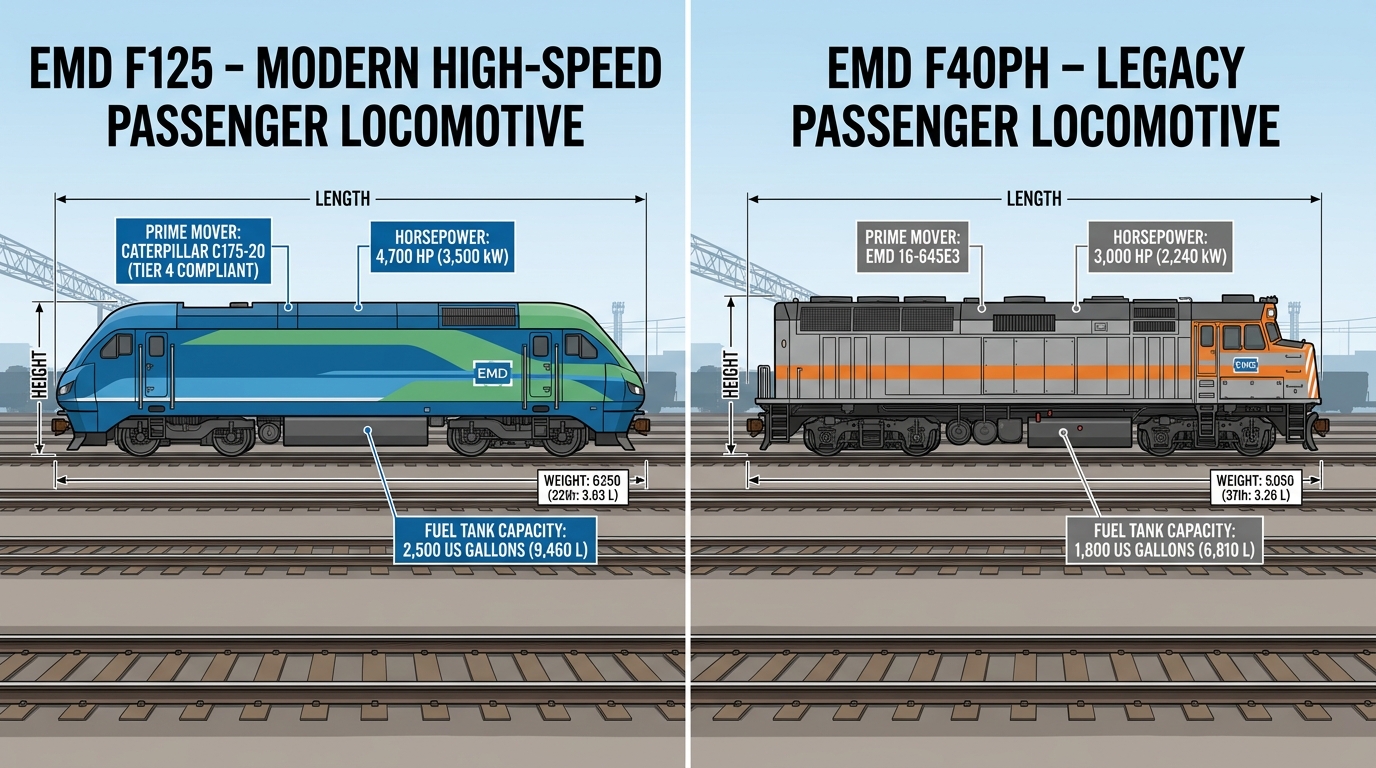
Key Technical Specifications of the EMD F125
| Specification | EMD F125 | EMD F40PH |
|---|---|---|
| Horsepower | 3,600 HP | 3,000 HP |
| Prime Mover | EMD 12N-710G3C-T3 | EMD 16-645E3 |
| Fuel Tank Capacity | ~2,000 gallons (~7,570 liters) | ~1,800 gallons (~6,810 liters) |
| Locomotive Weight | Approx. 280,000 lbs (127,000 kg) | Approx. 260,000 lbs (118,000 kg) |
| Length | ~71 feet (21.6 m) | ~56 feet (17.1 m) |
| Traction Motors | AC traction motors | DC traction motors |
| Emissions Standard | EPA Tier 4 compliant | EPA Tier 0 |
| Control System | Microprocessor-based | Analog relay logic |
The F125’s upgraded prime mover delivers higher horsepower while maintaining axle load restrictions suitable for commuter rail infrastructure.
Advanced Emission Control Technologies
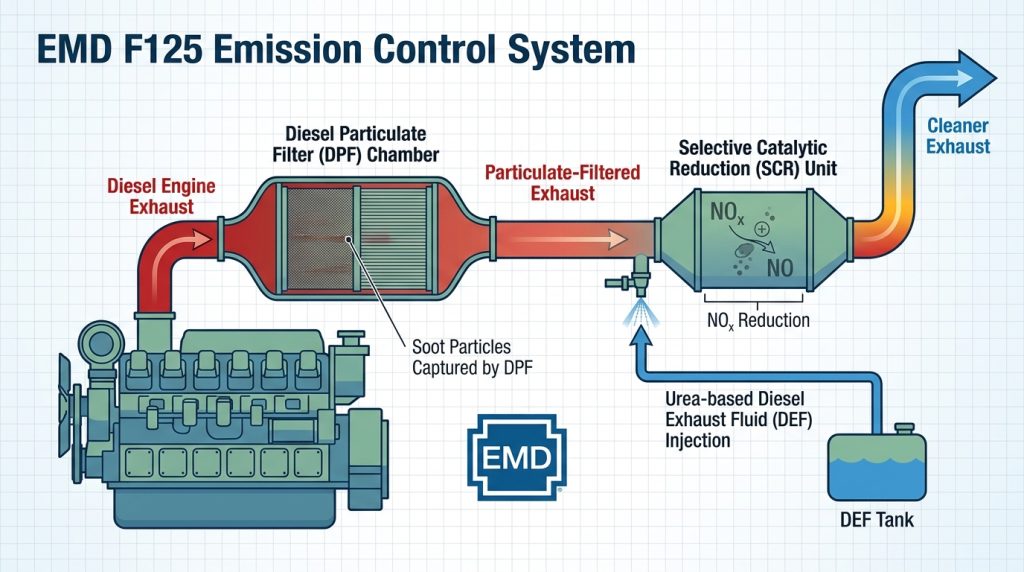
Unlike the F40PH’s era with minimal emission controls, the EMD F125 meets stringent EPA Tier 4 standards by integrating advanced emission reduction systems:
- Selective Catalytic Reduction (SCR): Injects urea-based Diesel Exhaust Fluid (DEF) into exhaust gases to reduce nitrogen oxides (NOx).
- Diesel Particulate Filter (DPF): Captures particulate matter (PM), preventing soot from being released.
- Improved Combustion Control: Microprocessor-managed fuel injection timing optimizes combustion efficiency to reduce raw emissions.
- Aftertreatment Monitoring: Continuous system checks ensure emission devices operate within regulatory parameters.
These technologies enable the F125 to significantly reduce NOx and particulate emissions compared to legacy models without needing full electrification of corridors.
Microprocessor Controls and Digital Diagnostics
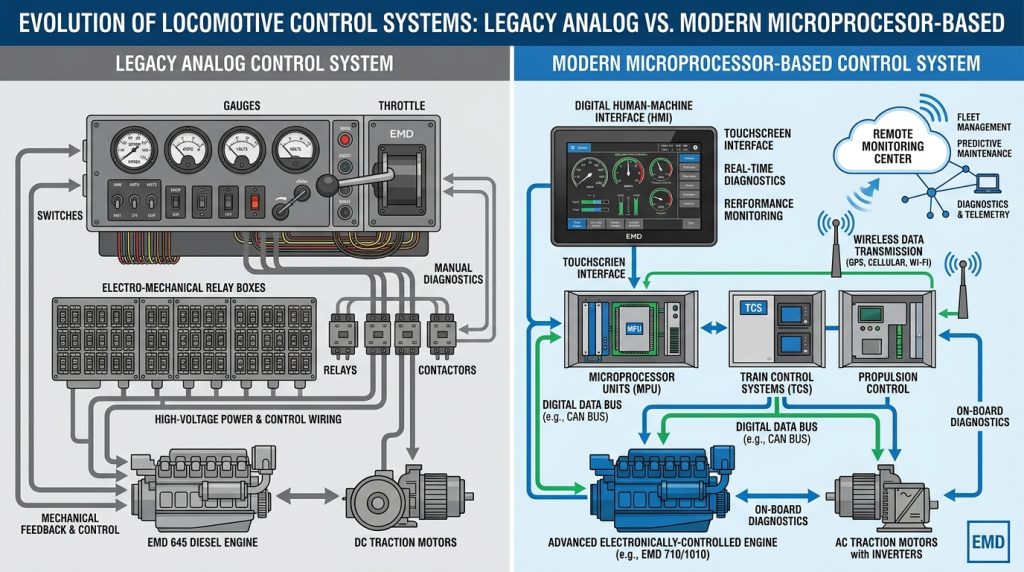
The mechanical simplicity of earlier models gave way to integrated digital systems in the F125:
- Microprocessor-Based Control Architecture: Replaces analog relays with software-driven command layers managing engine output, traction power, and auxiliary systems dynamically.
- Fault Isolation & Redundancy: Multiple redundant control paths protect against service interruptions by isolating faults without shutting down propulsion.
- Real-Time Data Transmission: Automatic data communication sends operational data to centralized maintenance teams while locomotives remain in service.
- Onboard Event Recorder: Logs system events and faults for safety compliance and troubleshooting.
This digital shift improves operational reliability by enabling predictive maintenance and minimizing unplanned downtime.
Operational Enhancements and Performance Improvements
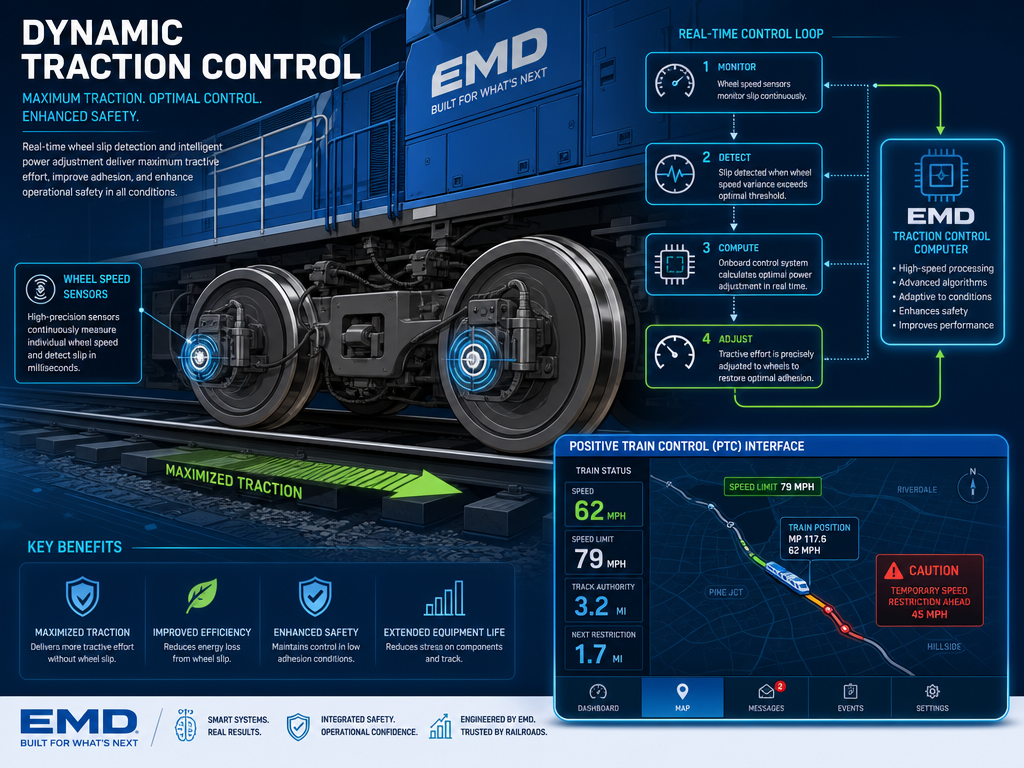
Adhesion Control and Wheel Slip Prevention
The F125 uses advanced traction control algorithms that monitor wheel slip continuously during acceleration or braking phases, optimizing adhesion to rails and reducing wear.
This is especially valuable for stop-and-go commuter rail service where traction loss can cause delays or damage.
Positive Train Control (PTC) Integration
The locomotive is designed for seamless interoperability with Positive Train Control systems mandated in North America:
- Enables remote speed monitoring
- Enforces safety limits to prevent collisions or derailments
- Supports real-time fault reporting integrated with network-wide safety controls
This modern signaling compatibility enhances overall system safety.
Safety and Crew Comfort Upgrades
Crashworthiness and Structural Reinforcements
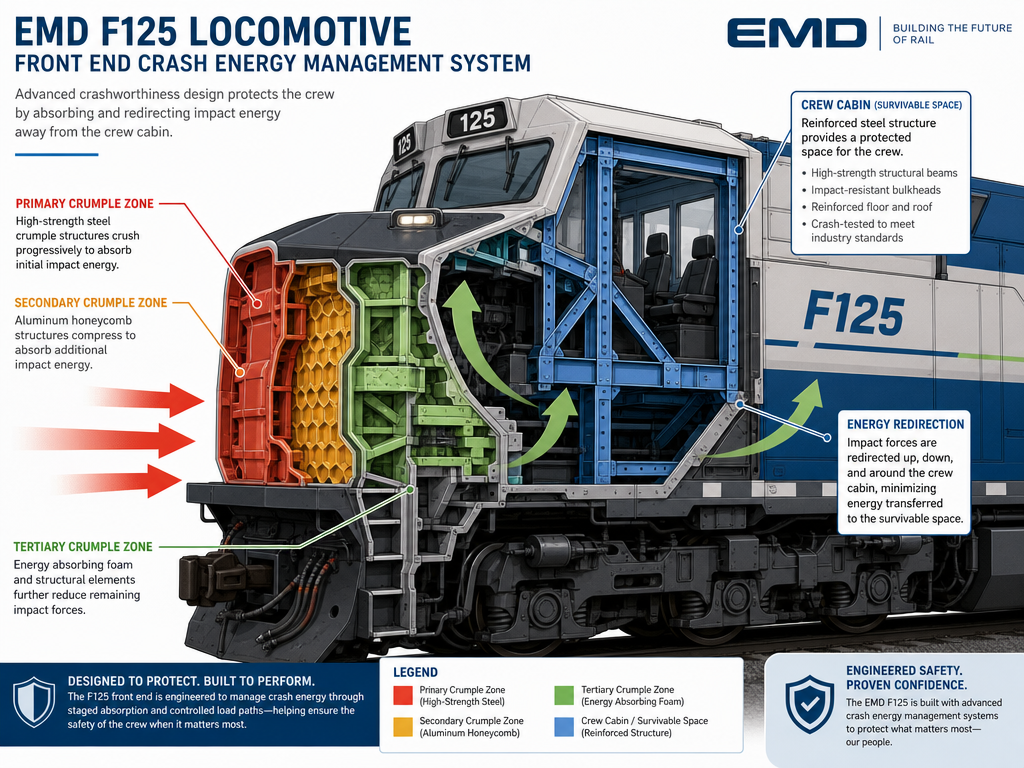
Designed to exceed current crashworthiness standards, the F125 features:
- Reinforced structural zones for impact energy absorption
- Crumple zones designed to protect crew compartments
- Improved frame construction using high-strength materials
These features reduce risk during collisions compared to older designs lacking modern crash energy management.
Ergonomics, HVAC, and Noise Reduction
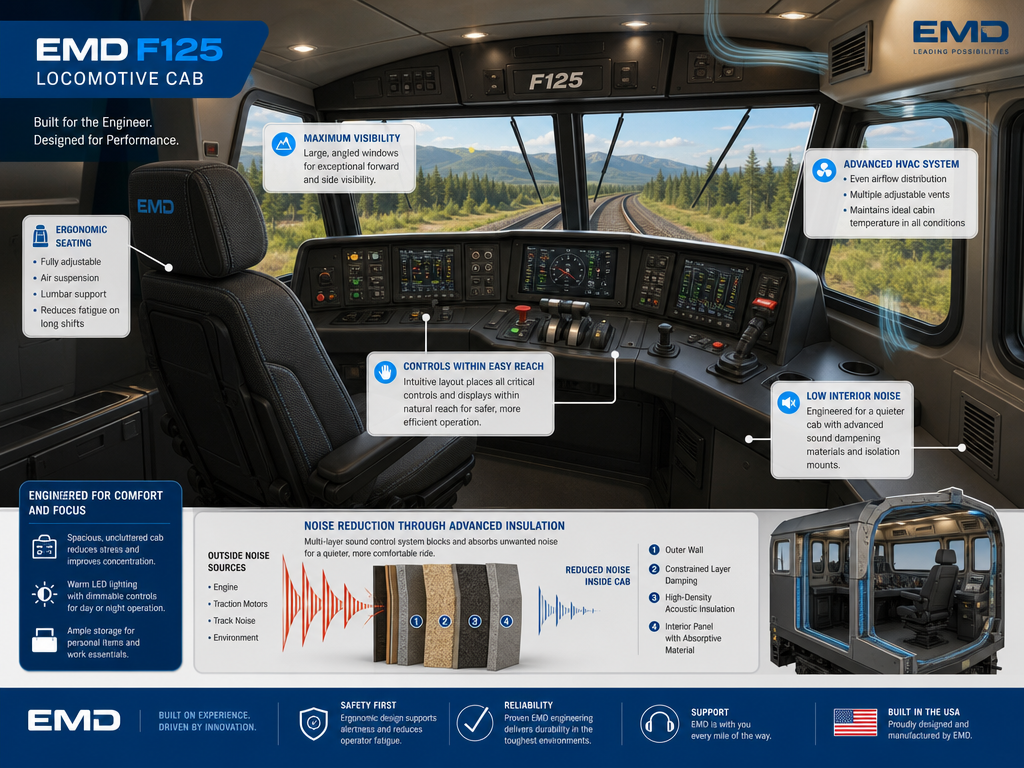
Crew comfort improvements extend beyond seating:
- Enhanced cab visibility with optimized window placement reduces operator strain
- State-of-the-art HVAC system maintains stable cabin temperatures in diverse climates
- Noise insulation materials minimize engine and aerodynamic sound reaching crew areas
- Vibration dampening reduces fatigue on long shifts
Together these upgrades improve crew performance and safety.
Maintenance Innovations and Lifecycle Management
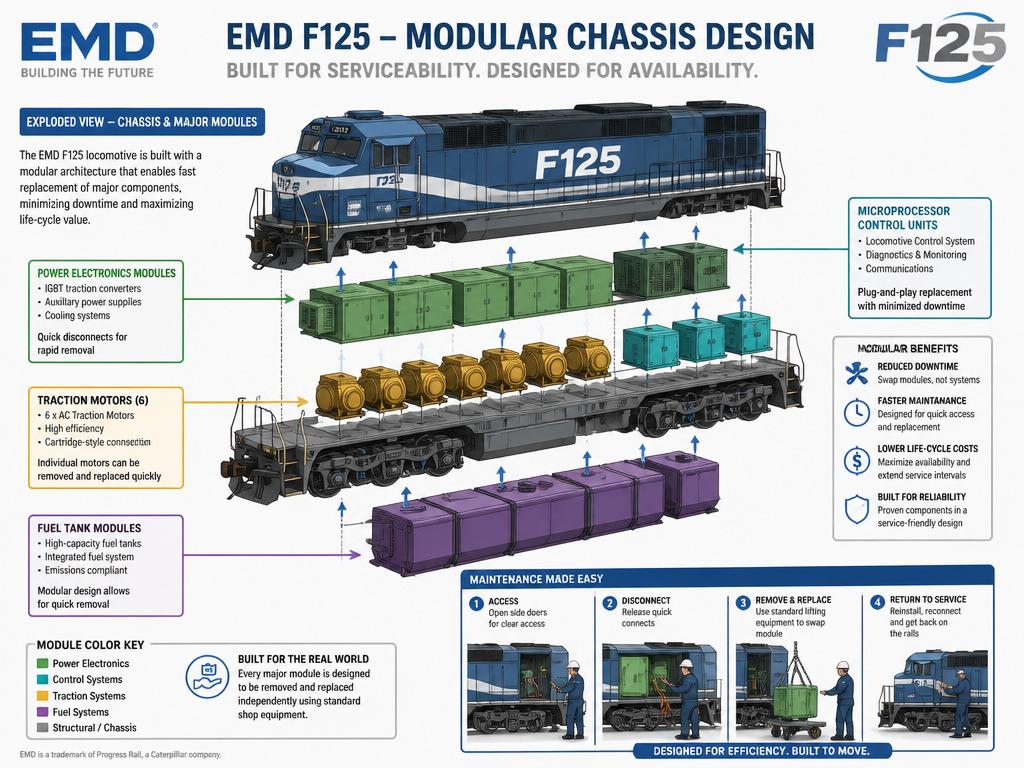
The F125 leverages modular design principles:
- Key components such as traction motors, power electronics, and control modules are designed for quick replacement.
- Maintenance intervals are extended due to improved diagnostics identifying wear before failure.
- Automatic fault reporting enables preemptive parts staging.
These features reduce time spent in shops and lower lifecycle maintenance costs.
Fuel Efficiency and Energy Management Systems
Fuel consumption is optimized holistically:
- Engine output is digitally matched to traction demand in real time.
- Auxiliary systems are dynamically managed to minimize energy waste during idle or station dwell.
- Regenerative braking recovers energy when possible.
These improvements translate into measurable fuel cost savings over older fleets.
Compatibility with Existing Infrastructure and Fleet Integration
The F125 maintains compatibility with existing:
- Track gauge and clearance profiles
- Platform heights
- Maintenance facilities and tooling
This allows phased fleet upgrades without costly infrastructure modifications.
Strategic Procurement Considerations and Lifecycle Cost Analysis
When evaluating total cost of ownership:
| Cost Factor | F40PH | F125 |
|---|---|---|
| Initial Purchase | Lower upfront cost | Higher upfront cost |
| Fuel Costs | Higher fuel consumption | Reduced fuel usage |
| Maintenance Demand | Frequent unscheduled repairs | Predictive maintenance reduces downtime |
| Emission Compliance | Non-compliant or costly retrofits required | Meets current standards out-of-the-box |
Procurement teams benefit from predictable operating costs, regulatory compliance without retrofit risk, improved uptime, and longer asset life in the F125 platform.
Comparison Table: EMD F125 vs. F40PH
| Feature | EMD F125 | EMD F40PH |
|---|---|---|
| Horsepower | 3,600 HP | 3,000 HP |
| Engine | EMD 12N-710G3C-T3 Diesel | EMD 16-645E3 Diesel |
| Fuel Tank Capacity | ~2,000 gallons | ~1,800 gallons |
| Emissions Compliance | EPA Tier 4 with SCR & DPF | EPA Tier 0 |
| Control System | Microprocessor-based digital | Analog relay logic |
| Traction Motors | AC traction motors | DC traction motors |
| Adhesion Control | Advanced wheel slip prevention | Basic adhesion control |
| PTC Integration | Fully compatible | Not supported |
| Crashworthiness | Reinforced structural zones | Standard structural design |
| Cab Ergonomics & HVAC | Enhanced visibility & HVAC | Basic ergonomic design |
| Noise Reduction | Acoustic insulation & vibration damping | Minimal noise mitigation |
| Maintenance Approach | Modular components & predictive diagnostics | Conventional maintenance |
| Fuel Efficiency | Optimized engine & auxiliary load management | Less efficient control |
Conclusion: The Future of Commuter Rail Power
The EMD F125 marks a major step forward from earlier passenger locomotives like the venerable F40PH. By integrating advanced microprocessor controls, cutting-edge emissions technology, improved safety features, enhanced crew comfort systems, modular maintainability, and compatibility with existing infrastructure, it delivers a comprehensive solution tailored to today’s commuter rail challenges.
Rail agencies adopting the F125 benefit from reduced environmental impact, lower lifecycle costs, greater operational reliability, and future-proof capabilities aligned with evolving regulatory landscapes.
Key Takeaways
- The EMD F125 replaces legacy analog systems with advanced microprocessor controls enabling real-time diagnostics and propulsion management.
- It meets stringent EPA Tier 4 emissions standards through SCR and DPF technologies not found on earlier models.
- Enhanced crashworthiness structures improve crew safety beyond previous designs.
- Ergonomic cab improvements include better HVAC systems and noise reduction measures.
- Modular design supports faster maintenance turnaround and predictive servicing.
- Compatibility with existing rail infrastructure avoids costly upgrades during fleet transitions.
- Positive Train Control integration aligns with modern safety mandates.
- Overall lifecycle cost benefits outweigh higher upfront investment compared to legacy units.
Leave a Reply
You must be logged in to post a comment.